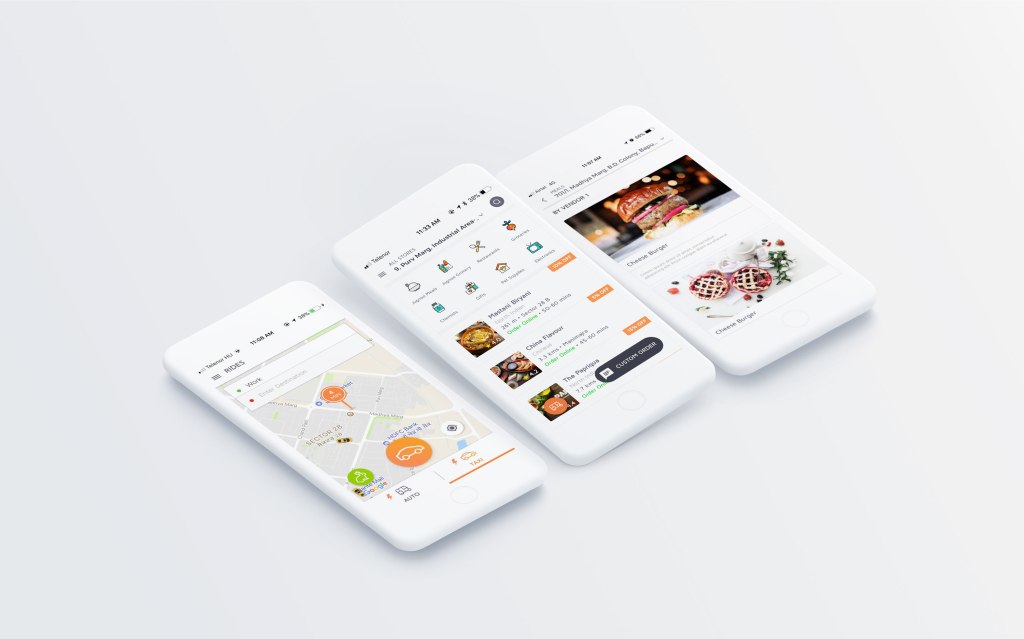
Jugnoo is a hyperlocal e-commerce application which brings the facilities provided by Uber, Zomato, and Ocado under one umbrella. With such an elaborate structure, it is easy to get overwhelmed and lose context, which ultimately brings fewer conversions.
The tuk-tuk booking service was performing better in comparison with the other two offerings. We wanted to identify the challenges with user experience of online food and grocery ordering.
Organisation: Jugnoo
Role: UI/UX designer
Team: Chinmay Agarwal, Isha Goyal
I worked with the co-founder of Jugnoo for this project and was mainly responsible for experience and visual re-design.
IDENTIFYING THE PROBLEM
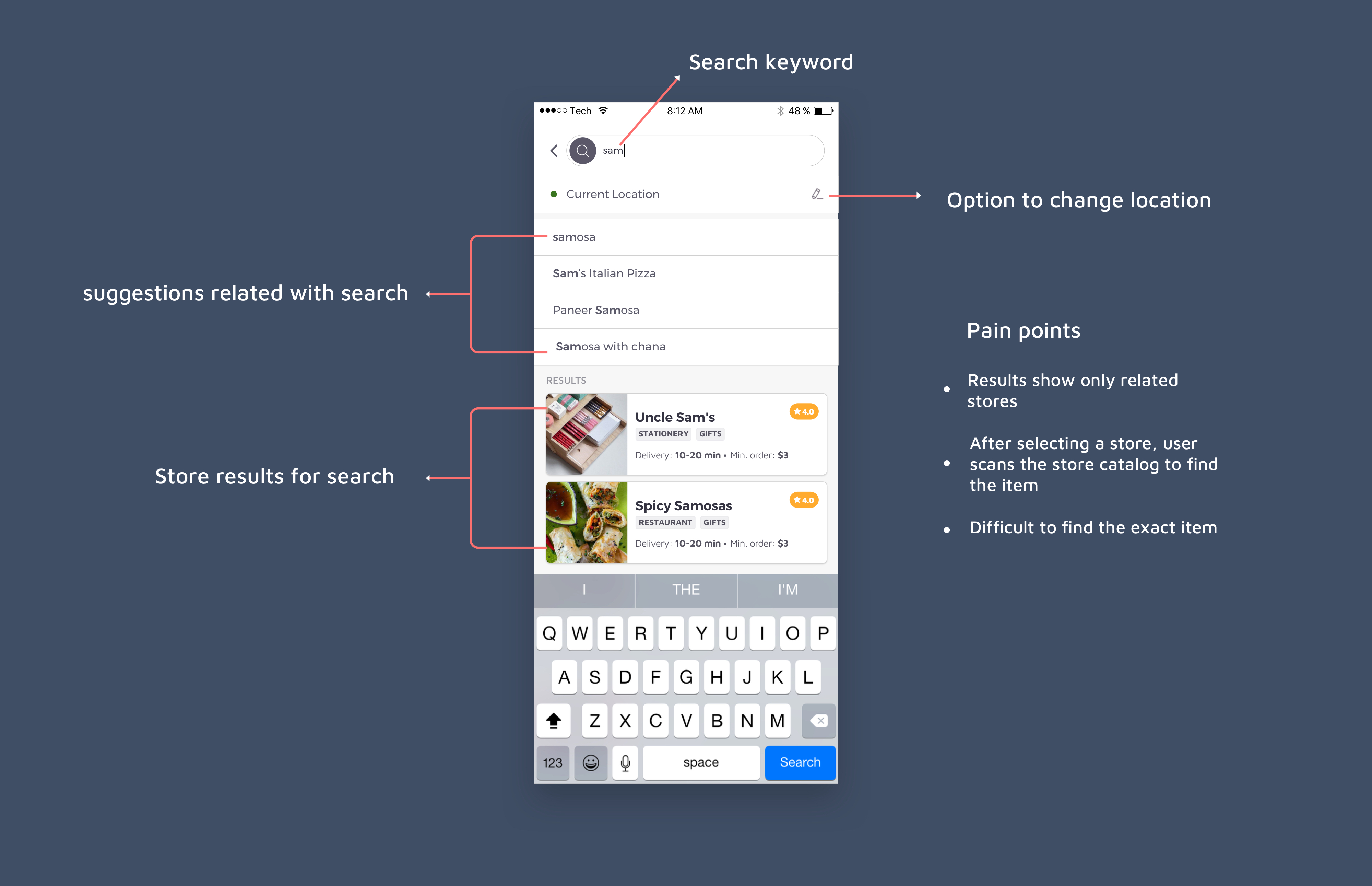
By understanding user behaviour through data analysis , we found that after using the search option users abandoned the application. After testing different scenarios it became evident that the search was not contextualised properly, thus, not giving desired results. The search option becomes essential when a user knows exactly what he/she is looking for but in Jugnoo the maximum one could get was a list of nearby stores which either offered something similar or the keyword matched their names and other suggestions based on the search.
ANALYSIS OF OTHER E-COMMERCE PLATFORM
It was important to acknowledge that Jugnoo’s business model worked on two different levels one, directly with customers and second, with other merchants. Jugnoo provided a platform for other merchants to sell their products and at the same time, acted as a merchant itself combining B to B and B to C models into one application. With constraints of the existing business model and design, we had to come up with a solution that would give equal visibility to all the merchants.
To improve the search I analysed other e-commerce platforms like Amazon and Flipkart which sell a wide variety of products to understand how their search is optimised and how that can be reflected in Jugnoo’s search.
THE SOLUTION
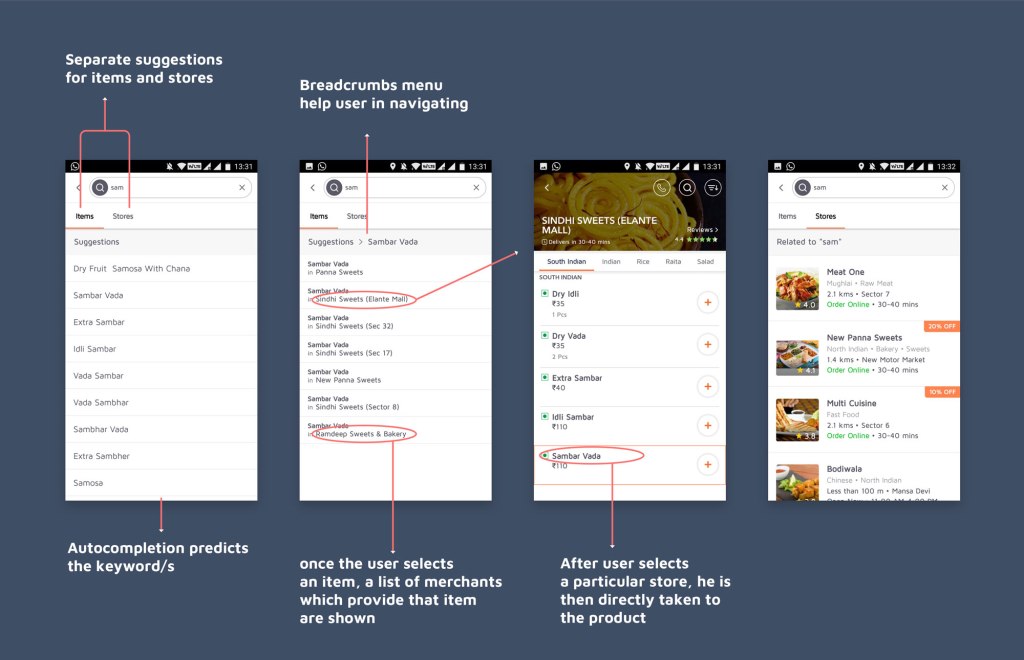
To make the search more user-friendly it was necessary that it should be re-modeled as per the modern day search methodologies. The separation of items from store results was essential as each store has its own catalog and different stores can have either entirely different catalogs or overlapping catalogs. While the items covered all the use cases of different and overlapping catalogs, searching for a store meant user knew from which merchant he would order.
This project helped me gain more insights about user experience and I learned how small improvements can make a large difference.

